Tom Ciurczak Album "Antarctica" Review

Updated: 2 hours ago
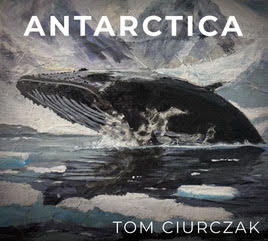
Artist: Tom Ciurczak
Album: Antarctica
Released: 2026
Artist Website: https://tomciurczak.com/
Tom Ciurczak is a southern California based singer/songwriter from the Springsteen school of music. Gritty rock and roll, story telling lyrics and memorable performances are what can be found on his releases. His music is high energy and recorded with vintage sounds. Real guitars being played through real amps with real speakers that are moving real air from the volume. He feels like a throwback to the late 70's or early 80's in the sense that he is more concerned with the performance than he is if the snare drum is EQ'd perfectly. It's more about the vibe of the song than it is a masterclass in modern recording techniques. But make no mistake it is a masterclass in rock and roll.
The title track Antarctica was a great choice for the first single. An ominous organ sets the mood at the top. There is something about a B3 that feels both dated and timeless simultaneously. It is really a wonderful sound that somehow transcends time while still making me think about yesteryear. At about a minute in a very Kinks-like guitar drops, taking the listener to an unexpected new place that is a hard left turn but somehow is executed quite smoothly.
Another cool riffy track is Looking For A Place. It is an upbeat rocker with an infectious guitar line. I find myself bopping my head to the riff and the drums that drive it with a pushy beat. Tom's vocals are always so authentic and this song is no exception. He isn't trying to force a sound through his throat that sounds fake. Instead he just sounds like an artist that is comfortable in his skin. The kind of comfort that comes from years of settling into one's artistic voice. Young artists more often than not are trying to impersonate their heroes versus just being the best version of themselves. Ciurczak is a shining example of the latter.
Going Down In Flames is a standout cut. The guitar comes roaring in with a natural crunch from the speakers that I imagine was quite fun to record. It sounds like it was cut at absurd volume levels. The kind of volume that only guitar players truly understand the allure of. I once heard a quote from Pete Townshend that was something along the lines of "Take a Les Paul and plug it into a Marshall stack. Turn it up to 10 and hit an open E chord... If that doesn't alter the course of your life, go to college, this isn't for you!" I get the sense Tom had that experience with an electric guitar pretty early on in life. This song captures that youthful snub to the neighbors that are annoyed by the band in the garage next door. Somehow all these years later Ciurczak is able to deliver that VERY rock and roll attitude both musically and vocally.
This ten song effort clocks in at about 35 minutes. Every song sounds just like Tom Ciurczak. Of course the listener can hear influences, but Ciurczak has reached a spot where the influences have taken a backseat to an artist's own voice. When informed listeners hear Stevie Ray Vaughan they know the two main ingredients were Jimi Hendrix and Albert King. But SRV took those influences and put them in a blender and out came the genius musician that we all know. It is the highest mountain to climb in music, the one that leads to a unique voice and Tom Ciurczak has attained it. This is a great rock and roll record in every way. Songs, production, performance and most importantly the attitude of youth, but the wisdom of years balancing that swag with more than a pinch of maturity!
Check out the interview with Tom below....
Tell us the brief history of your band or musical career.
I started playing guitar when I was about ten years old, growing up in New York's Hudson Valley. Music was always part of my life—my father was a professional musician at West Point—but like a lot of people, life and career took me in another direction for many years. I spent about 40 years in the Specialty Lighting business while continuing to write and play music. Eventually I reached a point where I could make music my full-time focus. Since 2020 I've released Call Me Ishmael, two volumes of I Ain't Ever Growing Up, California Christmas Tales, YORICK, and now ANTARCTICA, along with several singles and a collaborative roots album with the Copperhead Six Project. Today I work with a terrific group of musicians in Southern California and spend most of my time writing, recording and performing.
Who are your musical and non-musical influences?
Musically, I grew up on The Beatles, The Who, the Eagles and the great classic-rock bands. Later, I became heavily influenced by writers like Bruce Springsteen, Warren Zevon, Steve Earle, Tom Petty and John Mellencamp as well as the PROG bands of the 1970’s like; Genesis, Yes, Jethro Tull, Frank Zappa and one of my all-time favorites Gentle Giant. What attracts me to all of them is the creativity and originality of song writing, both musically and lyrically. Their songs are much more than simple melodies and lyrics. There is a sophistication and complexity that drew me in. Outside of music, I'm influenced by history, travel and interesting characters. Sometimes I'll come across a historical event or an unusual person and immediately start wondering what their story might sound like as a song.
What album has had the greatest impact on your life as a musician?
There are so many. Early on it was the Beatles White Album, which I considered their masterpiece. Then the PROG revolution hit and I fell in love with Genesis’s Selling England by the Pound and the Lamb, but then along came Bruce Springsteen’s Born to Run. I had the great fortune of seeing him perform it live, just when it was initially released, and I became a lifetime fan afterwards.
What’s your favorite accomplishment as a musician thus far?
I'm particularly proud that YORICK was voted Album of the Year in the 2025 Americana Highways Readers' Poll. Awards and recognition are gratifying, but what really meant something to me was knowing that people had connected with a collection of original songs and stories that I had created. I've come to this part of my musical life later than most people, so every indication that the music is finding an audience means a lot to me.
Tell me about your favorite performance in your career.
I've been fortunate to play some iconic venues, including the Whisky A Go-Go, The Mint, the Viper Room and the House of Blues, and to open for artists including ABC, Coco Montoya, the Freddy Jones Band and Tommy Tutone. Probably my favorite was our very first performance and it was at the ‘Coach House’ in San Juan Capistrano CA. We opened up for ABC and the house was packed. It was the culmination of alot of hard work and kickstarted the band.
What's new in the recording of your music?
My newest album, ANTARCTICA, continues the recording relationship I've developed with producer/drummer Stephen Haaker and engineer/producer Brett Grossman. We recorded at Sunset Sound and Cosmic Voyager, and I think we've become much more adventurous about arrangements, sounds and where a song can go. I'm less interested now in asking whether something fits neatly into a particular genre. If a song wants to become bigger, darker, stranger or more cinematic, we let it.
How has your music changed over the years?
I've become much more focused on storytelling. I often think of my songs as little three-act plays. I want to introduce a character or situation, take the listener somewhere, and have something happen before the song ends. Musically, I've also become more willing to move outside the boundaries of straightforward Americana or heartland rock. The foundation is still there, but the records have become more cinematic and adventurous.
What inspires you to write the music you write?
Stories. They can come from history, something I've seen while traveling, somebody I've met, a strange newspaper story, or simply a character who appears in my imagination. I'm fascinated by ordinary people who find themselves in extraordinary situations. Once I find the character and the conflict, the song usually begins to reveal itself.
What made you want to play the instrument you play?
I started playing guitar around age ten. My father was a professional musician, so music was already part of my world, but seeing The Beatles on The Ed Sullivan Show changed everything. Like millions of kids at the time, I looked at those guitars and thought, "That's what I want to do." I've been playing ever since.
How does your latest album differ from any of your others in the past?
ANTARCTICA is probably my most cinematic record. It's ten original songs that take place in very different worlds, but there's a darker atmosphere running through much of the album. The title song goes back to the Antarctic whaling industry of the 1920s and turns that history into a ghost story. Other songs deal with forgotten people, relationships, mortality and some pretty unusual characters. Musically, we allowed ourselves to follow those stories wherever they wanted to go.
How are you continuing to grow musically?
By deliberately putting myself in situations where I don't already know the answer. I keep writing, recording with musicians who challenge me, and experimenting with arrangements and styles. One of the advantages of making music at this point in my life is that I don't feel much need to chase what's fashionable. I'm much more interested in finding out what I'm capable of doing next.
Are there any musicians who inspire you that are not famous? What qualities do you admire about them?
Absolutely. I work with musicians who inspire me all the time. My band and the musicians I record with bring ideas to the songs that I never would have arrived at by myself. I admire musicians who listen rather than simply play—people who understand that the objective isn't to demonstrate how good they are, but to make the song better.
How would your previous band mates describe you and your work ethic?
Probably as prepared, persistent and very focused on getting the details right. I spent much of my professional life running a business, and some of that mentality undoubtedly followed me into music. When we're rehearsing or recording, I want everyone to have fun, but I also want us to show up prepared and make the most of the time we have together. I'm also very open to other musicians' ideas. If somebody has a better idea for one of my songs, I want to hear it.
If you could change anything about the music industry today, what would it be?
I'd like to see the value of the songwriter and the recording itself better reflected in the economics of streaming. Streaming has made it possible for an independent artist like me to reach listeners almost anywhere in the world, which is remarkable. But the compensation to the people who actually create and record that music hasn't necessarily kept pace with the value the music creates
What are your biggest obstacles as a musician?
Probably the biggest challenge for an independent artist today isn't making music—it's getting people's attention long enough for them to hear it. There is an enormous amount of music being released every day. You can make a record you're very proud of, but then you still have to find the audience for it. That's almost a completely different job.
What do you think the best aspects of the music business are?
The people and the connections. There's nothing quite like bringing a song into a studio that previously existed only in your head and hearing a group of talented musicians turn it into something real. And then there's the other end of it—somebody you've never met tells you that one of those songs meant something to them. That's hard to beat.
What strengths do you have that you believe make you the musician you are?
Persistence, curiosity and storytelling. I'm willing to keep working at a song until I find what it's really about. I also think having lived a lot of life before making music my full-time occupation gives me a pretty deep well of characters, places and experiences to draw from.
Do you have any weaknesses that you're actively working to improve on?
I'm probably more comfortable creating and recording the music than promoting myself. Self-promotion doesn't come particularly naturally to me. I'm learning, though, that if you believe in the work, telling people about it isn't bragging—it's simply giving the music a chance to find its audience.
Describe your favorite and least favorite part about being a musician.
My favorite part is creating something that didn't exist yesterday—a song can begin with a phrase or a guitar idea and eventually become this whole world populated by characters and sounds. My least favorite part is probably the amount of administrative and promotional work required of an independent artist. I'd happily trade a few spreadsheets for a few more hours in the studio.
What do you think about online music sharing?
It's an extraordinary way for independent artists to reach people. Someone thousands of miles away can discover one of my records without a record company or radio station acting as a gatekeeper. The challenge is making sure that accessibility doesn't come at the expense of fairly compensating the people who created the music.
Describe your creative process when you write new music.
Usually something catches my attention first—a title, a character, a historical event or an unusual situation. I start asking questions about it. Who is this person? What happened to them? What do they want? Then I begin building the song almost like a short film. The music and lyrics tend to develop together, and I'll keep rewriting until the story has somewhere to go rather than simply repeating the same idea for three or four minutes.
Give us some advice for new musicians just starting out in the industry.
Write a lot of songs. Play with musicians who are better than you. Listen when they offer ideas. Don't wait for somebody in the music business to give you permission to make a record. And don't measure your progress entirely by streams, followers or likes. Make something you're proud to put your name on. You can control that part.
How do you prepare for your performances and recording work?
Preparation is important to me. Before recording, I want the structure, lyrics and basic arrangement of a song developed enough that we're not wasting studio time figuring out what the song is. But I also don't want it so locked down that the musicians can't bring something unexpected to it. Live, rehearsal is about getting everyone comfortable enough with the material that we can stop thinking about the mechanics and actually perform it.
What do you like most about your new album?
I like that ANTARCTICA takes chances. It's still recognizably my music, but it goes into some darker and more cinematic territory. I'm especially proud that the ten songs feel like ten different stories rather than variations on one idea. I want someone to put on the record and wonder where the next song is going to take them.
How do you promote your band and shows?
It's a combination of social media, my website, email, radio and press promotion, streaming platforms and good old-fashioned personal outreach. As an independent artist I've learned that making the album is only half the job. You have to keep finding creative ways to introduce the music to people without making every interaction feel like an advertisement.
What is the best way to stay updated on current news; gigs, releases, etc.
The best place is TomCiurczak.com. That's where I keep the latest music, show dates and news, and from there people can also find my social media and streaming links.
Anything you would like to share, from new merch to upcoming shows/tours or songs/albums?
My new album, ANTARCTICA, was released September 18. It's ten original songs and probably the most cinematic record I've made so far. We're supporting it with live shows, new video—including a video for the title track—and new ANTARCTICA merchandise. Everything is available through TomCiurczak.com.
What's next for your band?
Right now, the focus is getting ANTARCTICA out into the world and playing the new songs live. I'm also continuing to write. I've learned that finishing an album doesn't seem to turn off whatever part of my brain is already thinking about the next one.
What are your interests outside of music?
I’m and avid sports fan and a huge fan of the New York Giants professional football team as well as the Army West Point College Football team. I also use to play a lot of pickup basketball and you can still find me out on the weekend mornings at the local courts hanging out with all my old friends.
Are there any artists outside of your genre that have had influence on the music that you enjoy? My father was a professional trombone player with the Army band at US Military Academy at West Point NY. It was a 125-man band and they would play everything from large classical concerts, to big band shows, jazz concerts Football Games, Parades etc. and from when I can remember as a young child growing up, I went to them all. So, I would say because of this exposure at such a young age, I have a wide appreciation of many different types of music, that maybe many others don’t have.
Anything Else You Would Like to Include?
The thing I'd probably add is simply an invitation to listen to ANTARCTICA as an album. I still love the idea of an album as a complete experience—ten songs that take you somewhere for 40 or 50 minutes. If somebody discovers one song and then decides to take that whole trip with me, that's about the best outcome I could ask for.


Comments